
By Maïna Durafour, Matt Corpuz and Kaily Martinez, University of Connecticut
When Connecticut’s minimum wage rose on Jan. 1 from $15 an hour to $15.69, it was good news for many workers. But for small business owners, the increase – the first in a series that will be tied to the cost of living – has created a lot of stress and concerns for the future.
Haley Adams, owner of Hale’s Barbershop in Coventry, said the growth in the minimum wage has far-reaching implications for small businesses.

“I would love to be able to provide full-time employment to every employee that I have, but I cannot because I simply couldn’t afford to pay them a full-time wage at $15.69 an hour without guaranteeing that I could get clients in the door for them,” Adams said.
“I work full time at my own business in order to supplement my income enough to provide for my employees as well as paying my own personal and business bills and taxes,” she explained. Adams said she often worries about losing business because of the size and scale of her work.
“I don’t have the kind of business that I can replace with a kiosk,” she said. “A hands-on business like mine, where you have to work one-on-one with a person, it affects me more greatly.”
Running the small business requires Adams to constantly have her “business brain” on, thinking of next steps for success, she said.
“I have a small family. I have a growing family. I have a small child,” Adams said. “It makes you worry about if you are able to continue to provide for them and give them the life they want.”
Some small business owners have had to close their businesses to pursue a more sustainable route financially, she said. Hale’s Barbershop is in a busy area that was once successful for small businesses owners. But now, only half of the storefronts are occupied.
“Oftentimes, those small business owners have to go to the larger business route and work under somebody else,” Adams said.
Price increases
This situation is familiar to Cheryl Preston, the owner of A Cupcake for Later, a bakery on Main Street in Willimantic. She opened her shop 13 years ago, and has seen and felt the numerous increase-of-living costs on her business.
“I pay more than minimum wage anyway so it’s not anything really drastic. Again, if worse came to worse and it was something I didn’t think I could afford, [employees would] be losing hours, I’d be putting in more hours myself,” said Preston.
Preston said that minimum wage increases have a direct effect on the cost of living.
“It gets frustrating because the people that are screaming for more money are the very people who are also screaming that you’re paying $5 for a cupcake. Again, you can’t have it both ways,” she said. “You can’t get a price increase or a raise and not expect prices to go up because how does that business owner make up for the difference?”
Preston said she had to increase her prices last year, but for now does not need to do so. However, it’s a consideration that is always in the back of her mind.
For Preston, the state’s annual increase of the minimum wage is frustrating for a different reason: it’s a raise not tied to merit.
“By just increasing minimum wage, it makes people lazy. Because all they think of is, ‘It doesn’t matter, I’m going to get a raise anyway,’ or, ‘It doesn’t matter, I’m going to make this much money anyway,’ because they don’t have to try,” Preston said.
According to Preston, increasing the minimum wage is not the solution to the main issue. She said state lawmakers should consider that the profits generated by small businesses are far from that of big corporations.
“What I feel the state should be doing is the big-box companies, Walmart, Stop & Shop, those big companies that make a ton of profit, those are the ones who should have a minimum wage, not necessarily a small mom-and-pop business that can’t afford it,” she said.
A better plan might be for lawmakers to focus on lowering the cost of living in Connecticut, she said, adding that lawmakers should focus on rent control, or car prices or gas costs rather than minimum wage.

At The Hoot gift store in Mansfield, owner Lisa Chesmer had several concerns about her business since the minimum wage increase in January. Reducing staff at The Hoot has been a consideration.
“It makes you be careful about how much, how many people you do have on. So we do pay close attention to busy times or slow times,” she said. “Right now, I say business has been good, so we haven’t had to really worry about that yet,” she said.
Chesmer said Christmas is the busiest season at The Hoot, so she typically hires more people to the team in September. Now, everything must be weighed carefully in advance.
“Payroll is one we are careful about – how many we hire and when we hire them,” she said.
Tipped wage
Connecticut lawmakers this session declined to pass a bill that would have eliminated the state’s tipped wage, which is prevalent in food service. Since 2017 the tipped wage has stood at $6.38 for wait staff and $8.23 for bartenders.
Peter Weeden, the general manager of Square Peg Pizzeria Storrs, has still experienced changes in operation since the minimum wage increase.
“For example, you have a server, slow day, there’s no guests or very little guests. They don’t make enough to cover their minimum wage. We take the difference, say, you know, $3 more an hour, $4 more an hour in order to get up to the $15.69,” said Weeden. “You can never pay under the minimum wage. You can pay more, but you cannot pay less.”
Even with the increase in minimum wage, prices have remained consistent at the Storrs branch of Square Peg Pizzeria. “We have not had the need here to raise prices to accommodate the minimum wage yet,” Weeden said.

As a business in a college town, Weeden has had to do a little bit of everything to keep business strong and customers coming.
“I’ve had to be more hands-on as opposed to being just a manager. You know, talking to guests and taking care of the guests. We cook, we host, we do all sorts of different things that we would normally have other people in that paid position,” Weeden said.
On Main Street in Manchester, a warm atmosphere welcomes guests as they enter Penny’s Place, a breakfast-and-lunch restaurant owned by Penny Braga.
Braga says she has not drawn a paycheck since the business opened two years ago and has been forced to change her style of business. Braga says eight months ago, she paid servers $15 per hour, but to save money resorted to paying them the lower tipped minimum wage. Now, servers are paid $8.50 per hour plus tips.
While the new hourly wage for servers did cut some costs at Penny’s Place, Braga says she noticed a drop in new employees’ work ethic. After a month of training, she says she’d notice they didn’t carry out their job responsibilities and frequently would make the same mistakes on orders, which cost her more money at the end of the day.

“I would love to have a couple of part-timers in here; I’ve given up,” Braga said. “We look for help, we get somebody in here, they last a month.”
Historical perspective
Joseph Grimaldi, who has owned the Manchester Tailor Shop for 60 years, says the minimum wage is not a livable income compared to when he opened his shop in 1964.
Connecticut’s minimum wage was $1.25 when Grimaldi opened.
Back then, Grimaldi recalled, he was able to live off the $400 a week the tailor shop would make. Now, earning at most $700 a week, Grimaldi said that’s why he still works at 90 years old – it’s not enough to cover all of his expenses.
“As a matter of fact, sometimes people say, ‘You still charge that kind of price?’ Which means I’m happy where I am. … What do I want to do? Take advantage of people to put an extra $50 in my pocket? It doesn’t work because those poor people can’t afford it,” Grimaldi said.
In the past few months, Grimaldi has had to raise the shop prices slightly to at least break even. However, he stressed the importance of not raising prices substantially because it would cost businesses their customers.

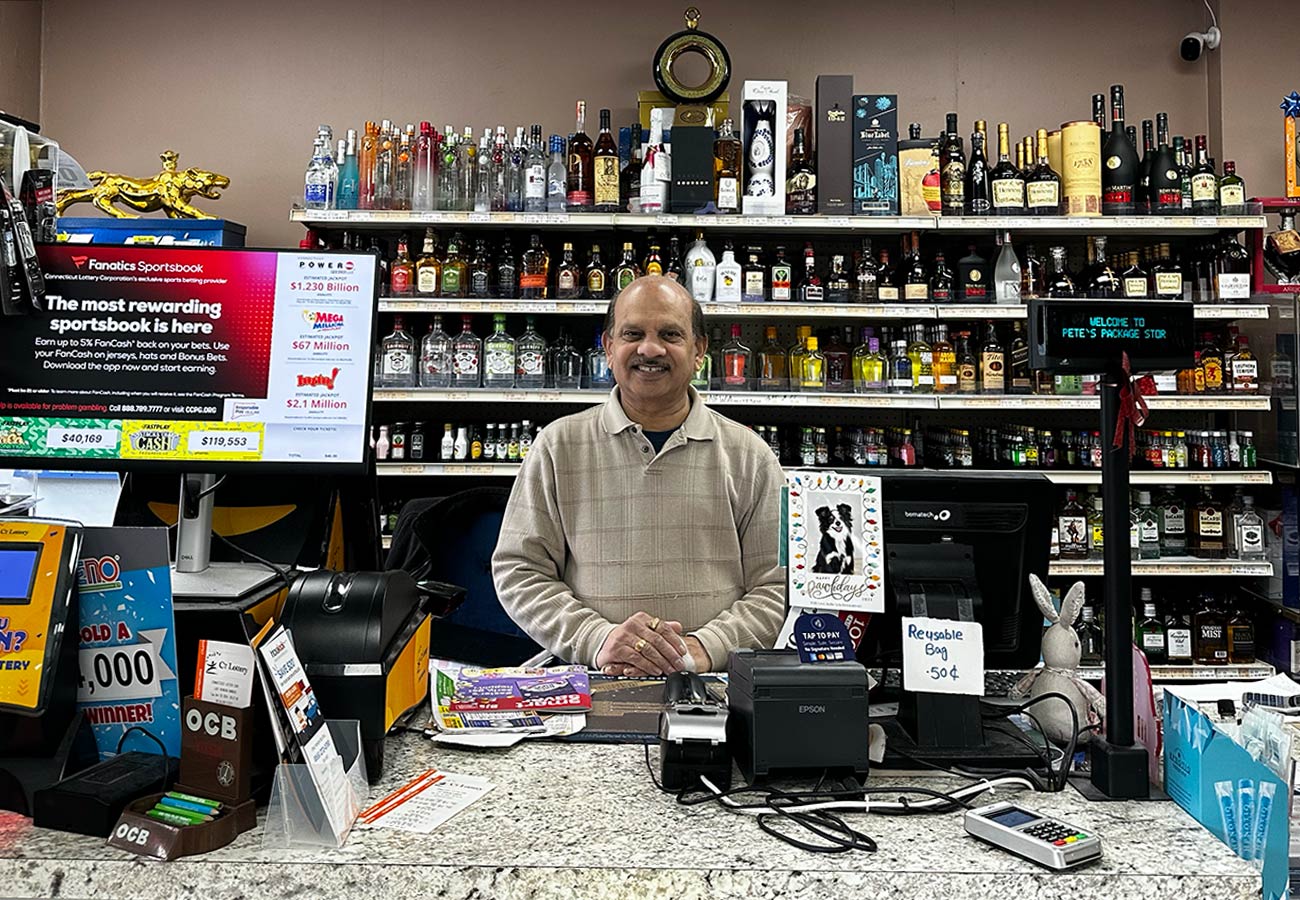
Pranay “Pete” Shah, owner of Pete’s Package Store, has been located in the same building in Manchester since 1995.
Before 2019, Shah’s business was a convenience store. Back then, it was easier to make a profit for a convenience store but it became a “dying business” as time went on, he said.
While both Shah and his wife are self-employed, Shah said prospective employees are seeking higher pay. On top of this, Shah said, some employees lack the drive to complete job responsibilities such as stocking shelves, and need constant reminders.
Hiring impact
In contrast, The Firestone Art Studio & Café in Manchester has hired more than 50 employees.
Danielle Pachkovsky, the general manager of both The Firestone Art Studio and The Claypen, works closely with the owner, Sophia Dzialo, when determining the day-to-day operations of both businesses.
Two years before the minimum wage hit $15 per hour, The Firestone Art Studio’s hiring wage was already at $15, said Pachkovsky. Prior to this, both Pachkovsky and Dzialo sat down and made a spreadsheet of their sales and labor goals to figure out how this could be done.
In addition, Pachkovsky and Dzialo use “sales forecasting” data from the previous year to determine what the current year’s busiest days will be to schedule more or less employees on each given day. This lessens the chance of starting the day with a negative number, said Pachkovsky.
“This is the way of the future, it’s the way it’s going to be. But, we also have to be realistic as a small business that it’s not easy to increase the minimum wage. But, it is a necessary future that we all have to be able to handle,” Pachkovsky said.
While the minimum wage will continue to rise each year, it is uncertain how much it will increase and what it will look like for small businesses.

As business owners deal with changing times, the minimum wage is a challenge we “have to face and meet head on,” Pachkovsky said.
Ilana Stollman, the director of retail operations of the Mark Twain Museum gift shop in Hartford, has also seen the impact of the minimum wage increase. The business plan for a nonprofit organization like the Twain House is different than for profit outlets.
Once a minimum wage increase is announced, it disrupts the whole nonprofit budget, which needs to be reconfigured.
“I have mixed feelings about it because I know from a budgetary standpoint, it’s difficult for a nonprofit to do,” Stollman said. “We’re not making money. We’re just here to support the museum.”
However, not every business has the possibility to finance increases as easily. “We just tighten our belts and try and make it work. Trying to spend less, trying to … get higher sales, higher margins,” she said.
So far, watching expenses carefully and raising the price on some items have been enough, but there is no guarantee of finances in the next few months or years. The minimum wage increase is hard to manage when businesses already face important increases in everything from electricity to the cost of goods and transportation.
“I understand both sides because I believe people should earn a living wage. But I also know the reality of our business at the moment,” said Stollman. “If we had more funding, that could be changed. But until and unless we’re getting more money to support the museum, I only have what I have.”
The increase in minimum wage also affects the cost of visiting the museum. Not every family can afford to visit the museum and that has a negative impact on opening culture to all. Stollman said she would like the government to provide more funding without nonprofits having to compete with other nonprofits.
“It’s not just like you knock on the door and say, ‘Hey, we need some help.’ There’s a lot of competition, there are a lot of nonprofits, and we’re all looking for the same dollars,” she said.